General
Sets of Numbers
Sets
| Symbol | Description |
|---|---|
| Set of all natural numbers | |
| Set of all integers | |
| Set of all rational numbers (Numbers that can be expressed as a fraction) | |
| Set of all real numbers (Any number) | |
| Set of all complex numbers |
Subscript / Superscript
| Symbol | Description |
|---|---|
| Set of all positive integers | |
| Set of all negative real numbers | |
| Set of all integers greater or equal to 12 | |
| Note: 0 is neither positive nor negative |
Summation and Product
Summation
Summation of arithmetic sequence
For arithmetic sequence :
Summation of geometric sequence
For geometric sequence :
Products
Properties (Theorem 5.1.1)
Properties of Integers
:
Closure
Integers are closed under addition and multiplication When you add or multiply an integer, you will get an integer and
Commutativity
and
Associativity
and
Distributivity
Multiplication is distributive over addition (but not the other way around)
Trichotomy
Exactly one of the following is true: or or
Logic
Logic Symbols
| Symbol | Meaning |
|---|---|
| There exists | |
| For all | |
| p implies q (if p, then q) | |
| p if and only if q This is a connective, like | |
| p if and only if q (p and q are equivalent) (This is the same as ?) | |
| p is equivalent to q (equal, but for logic) This is a “fact”, like | |
| x is an element of A | |
| A is a subset of B | |
| Difference between set A and B | |
| ~p | NOT p (Negation) |
| AND | |
| OR | |
| Set to be a working copy of (not a logic symbol) |
Logic Laws
Commutative
Associative
Distributive
- applying twice: and vice versa
Identities
Universal Bound
Negation
Double Negative
Idempotent
Absorption
Implication
- (Can be deduced from the point above)
- no name for this: this is derived from implication law, distributive law, negation law and identity law
De Morgan’s
These laws can be extended to more than two variables
Logical Arguments
Definition
An argument (argument form) is a sequence of statements (statement forms). All statements in an argument, except for the final one are called premises (or assumptions or hypothesis). The final statement is called the conclusion The symbol, , which is read “therefore”, is normally placed before the conclusion.
Example Argument
Note: this argument is invalid
Valid or Invalid
To say that an argument is valid means that no matter what statements are substituted for the statement variables in its premises, if the resulting premises are all true, then the conclusion is also true. i.e. For an argument to be valid: IF all premises are true, THEN conclusion must be true
Test Validity with Truth Table
- Identify all the premises and conclusion of the argument form
- Construct a truth table showing the truth values of all the premises and the conclusion
- Identify critical rows: Rows in which all the premises are true
- There is a critical row in which the conclusion is false The argument form is valid
- The conclusion in every critical row is true The argument form is valid
Syllogism
An argument form consisting of two premises and a conclusion
Modus Ponens
This is a commonly used form of syllogism: if then
Modus Tollens
Also a commonly used form of syllogism: if then
Rules of Inference
Rules of Inference are Logical Arguments that are valid. Rules of Inference can be chained together to prove more complex logical arguments.
Modus Ponens
if then
Modus Tollens
if then
Generalisation
The conclusion is a more general form of the premise: Anton is a junior (More generally,) Anton is a junior or Anton is a senior
Specialisation
Discard extraneous information to concentrate on the property of interest Ana knows graph algorithms and Ana knows numerical analysis (In particular,) Ana knows graph algorithms
Elimination
When there are two possibilities and one can be ruled out, the other must be the case
Transitivity
Proof by Division into Cases
Suppose one thing or another is true If in both cases, a certain conclusion follows, this conclusion must also be true
Contradiction
Conjunction Premises
Conditional (if)
Statements of the form is called the hypothesis or antecedent is called the conclusion or consequent “if , then ” ” only if ” ” is a sufficient condition for ” ” is a necessary condition for “
Vacuously True
In the case that is false, is true (vacuously true or true by default)
Implication Law
(Can be deduced from above)
Variants of Conditional Statements
Contrapositive
The contrapositive of is The contrapositive of “if p then q” is “if ~q then ~p” A conditional statement is always logically equivalent to its contrapositive e.g. If Howard can swim across the lake, then Howard can swim to the island If Howard cannot swim to the island, then Howard cannot swim across the lake
Converse
The converse of is The converse of “if p then q” is “if q then p”
Inverse
The inverse of is The inverse of “if p then q” is “if ~p then ~q”
Notes
The converse of a conditional statement the inverse of the logical statement (They are contrapositive) Summary:
- conditional statement contrapositive
- converse inverse
- conditional statement converse
Biconditional (iff)
Statements of the form ” if and only if ” or ” iff ” ” is a necessary and sufficient condition for ”
Logic Connectives
Order of Operations
- ~ (Not)
- and are coequal in order of operation (for CS1231S)
- and are coequal in order of operation
Examples
is unambiguous is ambiguous
Not (Negation)
Symbol
~ (also )
Truth Table
| p | ~p |
|---|---|
| T | F |
| F | T |
And (Conjuction)
Symbol
Truth Table
| p | q | p q |
|---|---|---|
| T | T | T |
| T | F | F |
| F | T | F |
| F | F | F |
Or (Disjunction)
Symbol
Truth Table
| p | q | p q |
|---|---|---|
| T | T | T |
| T | F | T |
| F | T | T |
| F | F | F |
Xor
Symbol
(Not used for CS1231S)
Truth Table
| T | T | T | T | F | F |
| T | F | T | F | T | T |
| F | T | T | F | T | T |
| F | F | F | F | T | F |
Implies
Symbol
Truth Table
| T | T | T |
| T | F | F |
| F | T | T |
| F | F | T |
If and Only If
Symbol
Truth Table
| T | T | T |
| T | F | F |
| F | T | F |
| F | F | T |
Logical Equivalence
Definition
Two statements are called logically equivalent iff they have identical truth values for each possible substitution of statements for their statement variables.
Notation
The logical equivalence of statement forms and is denoted by
How to Show Not
There are two ways to show that statement forms and are not logically equivalent:
Truth Table
Find at least one row where their truth values differ
Example
Show that and are not logically equivalent
| T | T | F | F | T | F | F |
| T | F | F | T | F | T | F |
| The last row of the table shows that they are not logically equivalent |
Counter example
Find concrete statements for each of the two forms, one of which is true and the other of which is false
Example
Show that and are not logically equivalent Let be true and be false Will evaluate to true Will evaluate to false Therefore, they cannot be logically equivalent
Quantified Statements
These are known as quantifiers
Universal Statement
Definition
Let be a predicate and the domain of A universal statement is a statement of the form "" i.e. Says that a certain property is true for ALL elements in a set
Example
All positive integers are greater than zero
Keywords
- All
- Every
- Any
Symbol
Negation
Negation of a universal statement (“all are”) existential statement (“some are not” / “there is at least one that is not”)
Notes
A value for for which is false is called a counterexample Implicit Quantification: Sometimes, quantification has to be inferred from context
- If then
- Is interpreted to mean: real numbers , (if then )
Conditional Statement
Definition
Says that IF one thing is true, THEN another thing also has to be true
Example
If 378 is divisible by 18, then 378 is divisible by 6
Keyword
if … then
Symbol
Universal Conditional Statement
Definition
Note: if not specified, “for all” is for the whole domain: , where is the domain of
Equivalent Forms
By changing the domain, a universal conditional statement can be converted to a universal statement: Suppose By narrowing to be the set of all values that make true, set ,
Negation
-(A) -(B) Substitute (B) into (A)
Vacuous Truth
is vacuously true or true by default iff is false for every in (or is an empty set)
Variants
Variants mentioned in Logical Conditional Statements can be extended to universal conditional statements They follow the same relations to each other (statement contrapositive etc.)
Existential Statement
Definition
Let be a predicate and the domain of An existential statement is a statement of the form "" Says that there is at least one thing for which the property is true
Example
There is a prime number that is even
Keywords
- There exists
- There is
- Some
Symbol
Negation
Negation of an existential statement (“some are”) universal statement (“none are” / “all are not”)
Notes
denotes “there exists a unique” or “there is one and only one”
Multiply Quantified Statements
Multiple quantifiers can be used for a single statement e.g.
Negation
Negate statements “from outside in”
Methods of Proof
Direct Proof
Prove that the product of two consecutive odd numbers is always odd
- Let and be the two consecutive odd numbers. 1.1. Without loss of generality, assume that , hence 1.2. Now, for some integer (by definition of odd numbers) 1.3. Similarly, 1.4. Therefore, (by basic algebra) 1.5. let which is an integer (by closure of integers under addition and multiplication) 1.6. Then, , which is odd (by definition of odd numbers)
- Therefore, the product of two consecutive odd numbers is always odd
WLOG
“Without loss of generality” may be abbreviated to WLOG
- This is used before an assumption in a proof which narrows the premise to some special case
- It implies that the proof of this special case can be easily applied to all other cases
Disproof by Counter Example
Prove that the following statement is not true: The product of two irrational numbers is always irrational.
- Let the two irrational numbers be and 1.1. Then, (by basic algebra), which , which is a rational number
- Therefore, the statement “the product of two irrational numbers is always irrational” is not true
Proof by Construction
Prove the following: s.t. (such that) and
- Let
- Note that and
- Also,
Notes
- Proof by construction is where you explicitly find the value with the correct properties
- It is a form of Direct Proof
- No need to explain how you found the result (e.g. 17), you just need to show that the result has the required properties
Proof by Contradiction
- Assume that ~S (not S) is true
- Based on this, use known facts and theorems to arrive at a logical contradiction.
- Since every step of the argument thus far is logically correct, the problem must lie in the assumption (that ~S is true)
- Thus, it can be concluded that ~S is false, that is, S is true
Example
Prove that is irrational
- Suppose not, that is rational 1.1. Then, s.t. (by definition of rational numbers) 1.2. Convert to its lowest term, 1.3. (by basic algebra) (note: this is done by squaring both sides of ) 1.4. Hence, is even (by definition of even numbers, as is an integer by closure) 1.5. Hence, is even (by Proposition 4.6.4 (has been proved somewhere else)) 1.6. Let ; Substituting into 1.3: , or 1.7. Hence, is even (by definition of even numbers) 1.8. Hence, is even (by Proposition 4.6.4) 1.9. So both and are even, but this contradicts that is in its lowers term
- Therefore, the assumption that is rational is false
- Hence is irrational
Proof by Exhaustion
Prove that the difference of two consecutive squares between 30 and 100 is odd
- The squares between 30 and 100 are 36, 49, 64 and 81 1.1. Case 1: which is odd 1.2. Case 2: which is odd 1.3. Case 3: which is odd
- Therefore, the difference of two consecutive squares between 30 and 100 is odd
Note
- Also known as proof by cases, or proof by brute force
- This is suitable when the number of cases is finite
Sets
Properties of Sets
Laws
All sets referred to below are subsets of a universal set
Commutative
Associative
Distributive
Identity
Complement
Double Complement
Idempotent
Universal Bound
De Morgan’s
Absorption
Complements of and
Set Difference
Subset Relations
Inclusion of Intersection
Inclusion in Union
Transitive Property of Subsets
Set Notation
Operations
Cartesian Product
(pronounced cross ) It is the set of all ordered pairs , where is in and is in is the set of all ordered -tuples where times Note: is different from
Union
is the set of all elements that are in at least one of or
Intersection
is the set of all elements that are common to both and
Union or Intersection of Indexed Collection of Sets
Given sets
Difference (Relative Complement)
or is the set of all elements that are in but not
Complement
or is the set of all elements that are in that are not in
Partitions
Sets can be divided into mutually disjoint pieces. Such a division is called a partition, which is also a set e.g. , then is a partition of Elements of a partition are called components of the partition Formally, either: is a partition of a set if the following hold
- is a set of which all elements are non-empty subsets of
- for all
- Every element of is in exactly one element of
- and or: A partition of set is a set of non-empty subsets of such that (note: means there exists a unique)
Power Sets
is the set of all subsets of . It includes Cardinality of power set: , then
Representing Sets
Set Roster Notation
Write all elements between braces Order and duplicates do not matter
Set Builder Notation
the set of all in such that is true: or
Replacement Notation
The set of all where : or
Interval Notation
Notation for subsets of real numbers that are intervals
Comparing Sets
Subset
is a subset of , every element of is also an element of
Proper Subset
is a proper subset of if AND
Others
Cardinality of a Set
denotes the cardinality of a set The number of elements in the set e.g.
Membership
means is an element of means is not an element of
Empty Set
Set containing no elements is NOTE: For all sets ,
Singleton
A set with exactly one element
Disjoint
Disjoint: Mutually Disjoint: for : For
Set of Equivalence Classes
For set and equivalence relation on , the set of all equivalence classes with respect to is denoted (“the quotient of by “) see Equivalence Relations
Set Equality
iff every element of is in and every element of is in Either: Or:
Proving Equality
To prove , prove that: and
Ordered n-tuples
An ordered pair is an expression of the form This is extended to -tuples
Equality
Two ordered pairs are equal iff and This is extended to -tuples
Relations
Relation (between two sets)
Let and be sets, a binary relation from to is a subset of . Given an ordered pair in , is related to by , or is -related to .
Relation on a Set
A relation on set is a relation from to It is a subset of () Note: the arrow diagram of such a relation can be modified so that it becomes a directed graph
Notation
is related to by means means
Domain, Co-domain, Range
Let and be sets and be a relation from to
Domain
is the set
Elements in that are “part of”
Co-domain
is the set
Range
is the set
Elements in A that are “part of”
Inverse Relation
If is a relation from to , then a relation from to can be defined by interchanging the elements of all the ordered pairs of Either Or
N-ary Relations
A -ary relation involves sets. Given sets , an -are relation on is a subset of 2-ary, 3-ary and 4-ary relations are called binary, ternary and quatenary relations respectively
Examples
1: Relation
Let and Suppose we define the relation R such that iff Then, but
2: Defining Relations
Let and Relation is defined from to as: State explicitly which ordered pairs are in and which are in
3: Domain, Co-domain, Range
Let and , and define a relation from to as follows:
Properties of Relations
Properties of Set Relations Note: These are properties of relations, not elements of sets (“element 0 is reflexive” is wrong, “the relation is reflexive”)
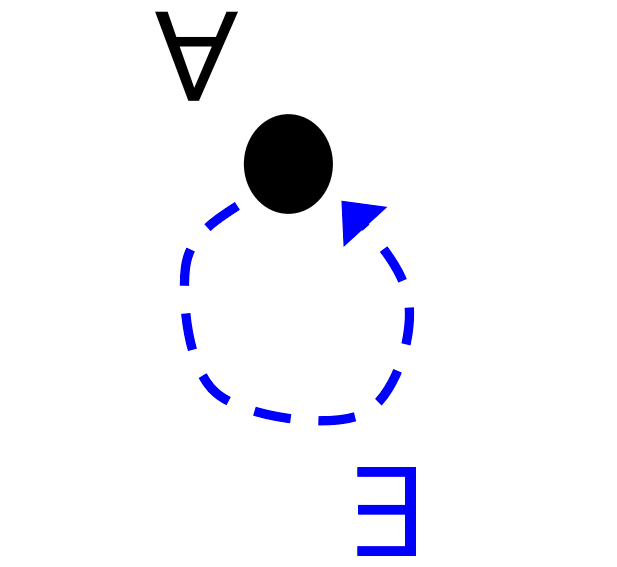
Reflexive
Definition
is reflexive iff all elements in the set are related to themselves
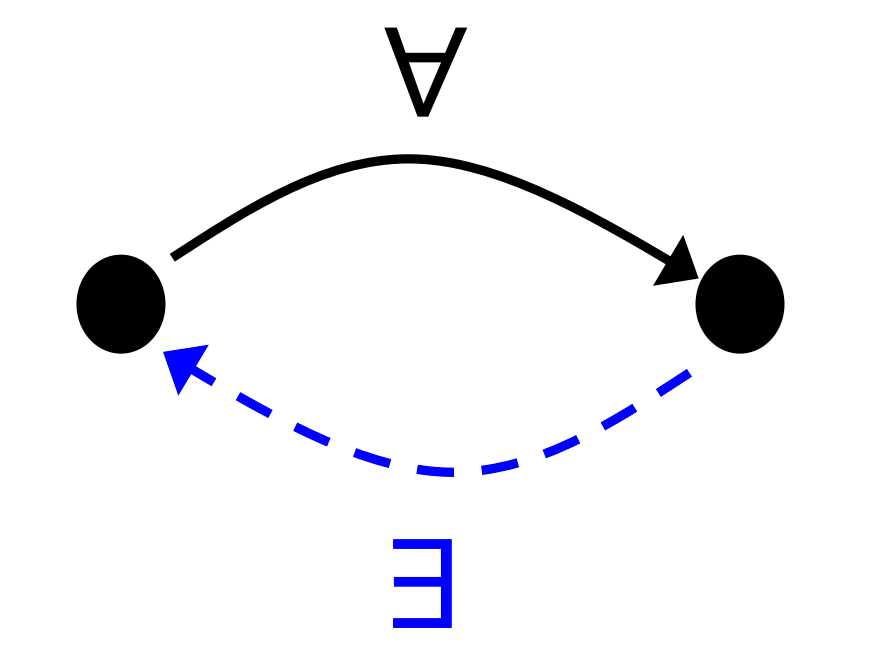
Symmetric
Definition
is symmetric iff for all elements that is related to , is also related to
Not Symmetric
Negation of definition of symmetric
Antisymmetric
There does not exist elements where is related to and is related to Let be a relation on set . is antisymmetric iff
Different from not symmetric
- Not symmetric
- At least one pair of elements is only related one way
- Asymmetric
- Not a single pair of elements are related “two-way”, including two of the same element (i.e. no element is related to itself)
- Antisymmetric
- Not a single pair of elements are related “two-way”
Asymmetric
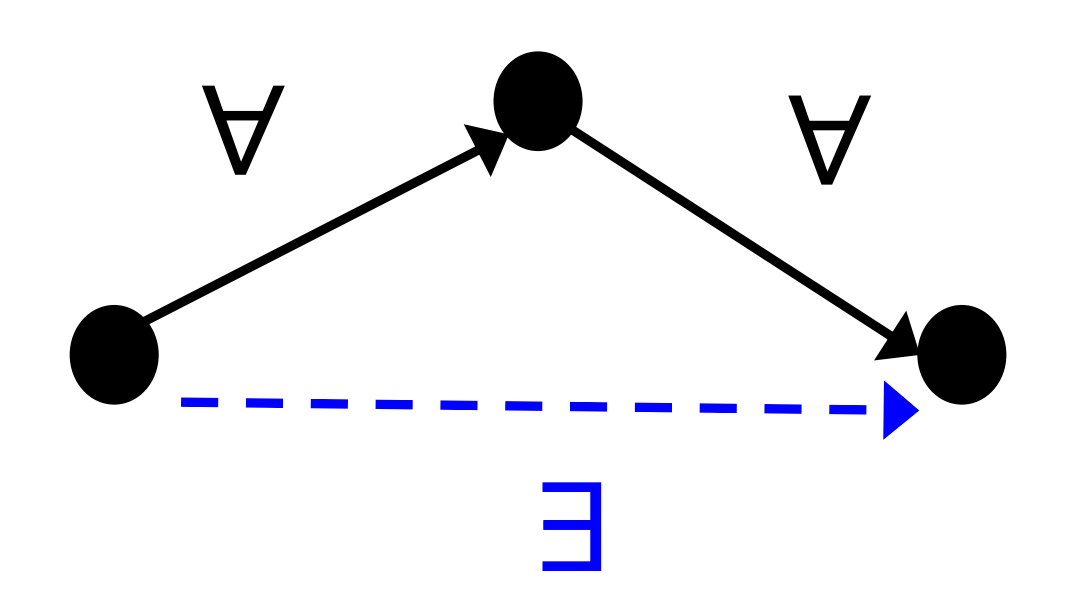
Transitive
Definition
is transitive iff for all elements that is related to , and is related to , is related to
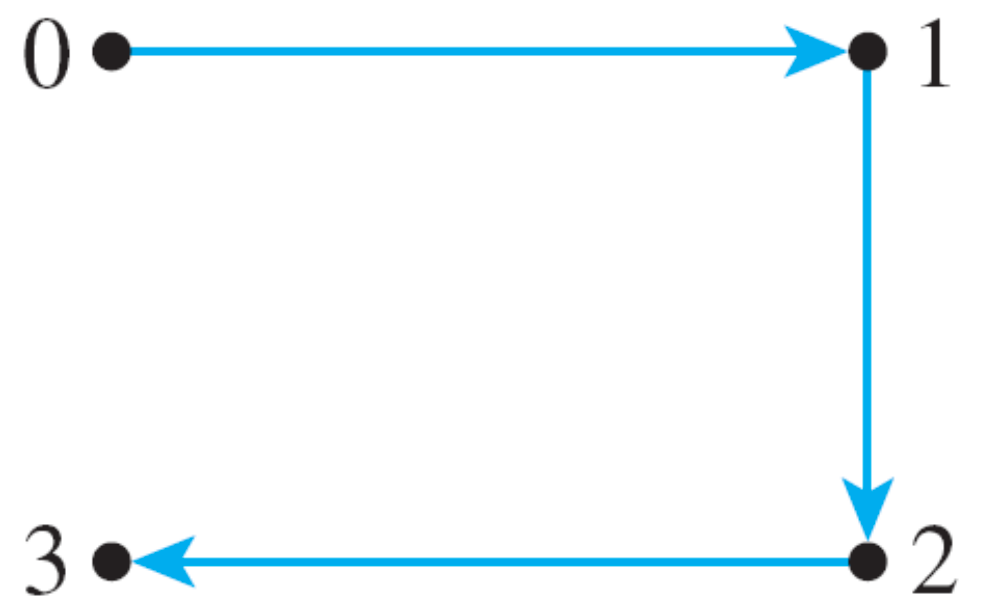
Transitive Closure
The transitive closure of a relation , denoted as , is the smallest superset of that is transitive i.e. To find , add the least number of arrows to the directed graph of to make it transitive Note: when trying to find the transitive closure, keep checking for transitivity after each round of adding arrows Formally, it satisfies all the following:
- is transitive
- If is any other transitive relation that contains (), then
- This means that is the smallest possible relation that is transitive
Example
Set Relation Properties 2024-10-04 02.56.54.excalidraw
⚠ Switch to EXCALIDRAW VIEW in the MORE OPTIONS menu of this document. ⚠ You can decompress Drawing data with the command palette: ‘Decompress current Excalidraw file’. For more info check in plugin settings under ‘Saving’
Excalidraw Data
Text Elements
Embedded Files
cbab65d6da187952222c5b0a286ec6ae3bf5e847:
1e4bb51a12f788d49cec5e422dae640587999f05:
95c5e3e3e5745bb8853e43e00feaabf3653d520d: image_1.png
4dbe37140d70d8134521bd5e2738f6238f412955: image_2.png
Link to original
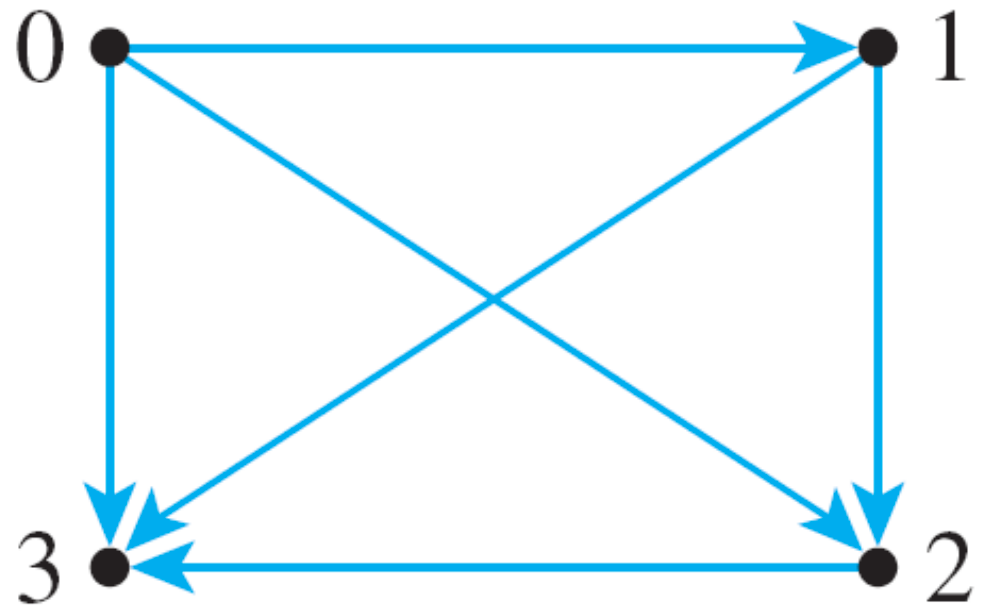
Relation Induced by a Partition
Given a partition of a set , the relation induced by the partition is defined on as: , a component of such that A partition is the same as an Equivalence Relations, but from different perspectives.
Properties
A relation induced by a partition is reflexive, symmetric and transitive
Example
Let set Let partition of the set Relation induced by the partition is:
Relation Diagrams
Arrow Diagram
Let and . Define relations and from to as follows: ,
Set Relations 2024-10-03 17.49.49.excalidraw
⚠ Switch to EXCALIDRAW VIEW in the MORE OPTIONS menu of this document. ⚠ You can decompress Drawing data with the command palette: ‘Decompress current Excalidraw file’. For more info check in plugin settings under ‘Saving’
Excalidraw Data
Text Elements
1
2
3
1
3
5
S
1
2
3
1
3
5
T
Link to original
Directed Graph
Only for relations on a set. Let , and define on as:
Set Relations 2024-10-03 20.23.45.excalidraw
⚠ Switch to EXCALIDRAW VIEW in the MORE OPTIONS menu of this document. ⚠ You can decompress Drawing data with the command palette: ‘Decompress current Excalidraw file’. For more info check in plugin settings under ‘Saving’
Excalidraw Data
Text Elements
3
4
6
5
Link to original
Relation Composition
Definition
Let , and be sets. Let be a relation, and be a relation. The composition of with () is the relation from to such that: i.e. and are "" related iff there s a “path” from to via some intermediate element in the arrow diagram
Laws
Let , , and be sets. Let , and be relations.
Associative
Inverse
Partial Order Relations
Definition
A relation is a partial order relation (or partial order) iff it is reflexive, antisymmetric and transitive. is used to denote a partial order relation (it replaces in , so ), read ” is curly less than or equal to “
Partially Ordered Set
A set is a partially ordered set or poset with respect to a partial order relation on , denoted by A set with a partial order relation defined on it can be represented and be called a poset
Hasse Diagram
Partial order relations can be represented as hasse diagrams
- Start with a directed graph
- Remove loops on nodes (because reflexive)
- Arrange nodes such that all arrows are pointing up, then remove arrow heads (because antisymmetric)
- Remove arrows that are implied by transitivity
- If there is an arrow from to and to , remove the arrow from to
- Keep repeating to remove as many arrows as possible
Example
For the “divides” relation on set
Partial Order Relations 2024-10-05 06.21.24.excalidraw
⚠ Switch to EXCALIDRAW VIEW in the MORE OPTIONS menu of this document. ⚠ You can decompress Drawing data with the command palette: ‘Decompress current Excalidraw file’. For more info check in plugin settings under ‘Saving’
Excalidraw Data
Text Elements
Directed Graph
Hasse Diagram
Embedded Files
200bb00677aa83342ccef1087c52e673c454aa82: image.png
acb4d4eb3d78d42155a9149398dea983c5eba8d5: image_0.png
Link to original
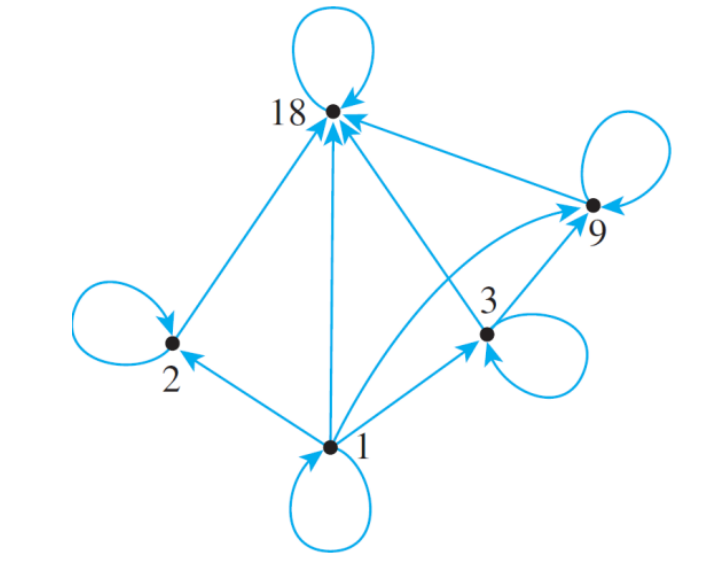
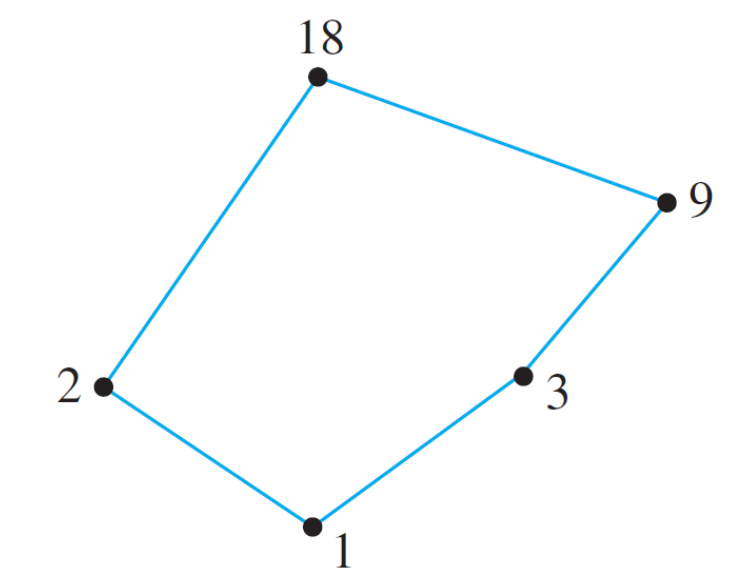
Formal Definition
Let be a partial order on a set . A Hasse diagram of satisfies the following condition for all distinct : If and no is such that , then is placed below with a line joining them, else no line joins and
Analogy
Putting on socks and shoes (ignore reflexivity)
- left sock must go on before left shoe, same for right
- but whether the left or right sock goes on first does not matter
- whether the left shoe goes on before the right sock does not matter
- left sock left shoe
- right sock right shoe
- the order is “partial” because there may not be an order between certain elements
- left sock and right sock are not comparable
Common Examples
- The “divides” relation, , on a set of positive integers
- on a set of real numbers
- on a set of sets
Properties of Poset Elements
Suppose is a partial order relation on a set
For example, the hasse diagram of on
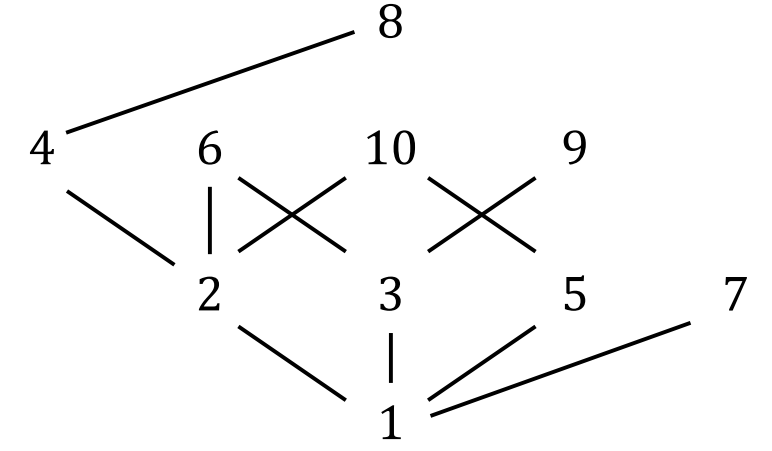
Comparability
Elements and of are said to be comparable iff either or . Otherwise, and are noncomparable Hasse diagram: Comparable means having a path between the elements that only goes up In the example and are comparable, but and are not
Compatibility
Elements and of are said to be compatible iff there exists such that and
Hasse diagram: The elements have have a path upwards to the same elements
In the example, and , and are compatible but and are not
Maximal Element
Element of is a maximal element of iff , either or and are noncomparable Hasse diagram: There are no lines upward from the element In the example are the maximal elements
Minimal Element
Element of is a minimal element of iff , either or and are noncomparable Hasse diagram: There are no lines downward from the element In the example is the maximal elements
Largest Element
Element of is the largest element of iff A largest element is always also maximal Note: largest element = greatest element = maximum Hasse diagram: There is a path downwards to all other elements In the example there is no largest element
Smallest Element
Element of is the smallest element of iff A smallest element is always also minimal Note: smallest element = least element = minimum Hasse diagram: There is a path upwards to all other elements In the example is the smallest element
Linearisation
Creating a Total Order Relations from a partial order, without violating the partial order relation Let be a partial order on a set . A linearisation of is a total order on such that
Example
For the “divides” relation on
 Linearisations will include:
- etc.
Kahn’s Algorithm
An algorithm that takes a finite set and a partial order on , and outputs a linearisation of Informally:
- Find the a minimal element of
- Remove the element from
- Repeat until
- The linearisation is the elements that were removed, in the order of removal
Total Order Relations
If is a partial order relation on set , and for any two elements and in , either or , then is a total order relation (or total order) on is a total order iff is a partial order and Also called a linear order
Example
The relation on is a total order because
Well-Ordered Set
Let be a total order on a set . is well-ordered iff every non-empty subset of contains a smallest element
Equivalence Relations
A relation is an equivalence relation iff it is reflexive, symmetric and transitive. is commonly used to denote an equivalence relation (it replaces in , so ) This is the same as a partition, but from a different perspective
Equivalence Class
The equivalence class of an element is the component of the partition that contains the element e.g. Partition , the equivalence class of , denoted is Formally, Suppose is a set and is an equivalence relation on . For each , the equivalence class of , denoted , called the class of for short, is the set of all elements such that is -related to . Symbolically,
Lemma Rel.1 Equivalence Classes
Let be a equivalence relation on a set . The following are equivalent for all .
Set of equivalence classes
For set and equivalence relation on , the set of all equivalence classes with respect to is denoted (“the quotient of by “) This is a partition of (Theorem Rel.2)
Theorem Rel.2
Equivalence classes form a partition Let be an equivalence relation on set , then is a partition of
Common Example: Congruence Relations
Congruence
Let and is congruent to modulo iff ( is divisible by ) can be written as
Congruence Relation
Congruence modulo (mod-) relation :
The quotient where is the congruence-mod-n relation on is denoted
Properties
Congruence modulo relation is an Equivalence Relation, i.e. it splits the set of integers into partitions.
Divisibility
Definition
If and are integers and , then is divisible by iff equals times some integer
Notation
means ” divides ”, if and such that
Quotient-remainder Theorem
Given any integer and positive integer , there exist unique integers and such that and , with remainder
Example Use
let: Is a partition of ?
Yes. By the quotient-remainder theorem, every integer can be written in exactly one of the three forms: , , or for some integer . This means that are mutually disjoint and
Functions
Function
A function from a set to a set , denoted is a relation that satisfies the following ( is well-defined)
- (all the in 1. is unique)
or
Let be a relation on sets and i.e. . Then is a function from to iff
or
or
A function from to is a mapping from each element of to exactly one element of
i.e. in the function diagram, there is only one arrow coming out from every element of and every element of has an arrow coming out of it
or
A function is well-defined (exists), if it has the following property:
Definitions
- let be a function. iff
- is the argument of
- is the image of under
- If then is a preimage of
- is the domain of
- is the co-domain of
- range is all possible outputs of , or the setwise image of under
- two functions can be derived from
- is the setwise image of
- is the setwise preimage of
- if , then let
- if , then let
- is the setwise image of , and is the setwise preimage of under
- note: here is not an inverse function although they have the same symbol. can also be written
- e.g. defined . and because and
- Setwise preimage function always exists
- Order of a bijection is the number of times a function has to be composed with itself to result in the identity function
- For a bijection of order :
Equality of Functions
and are equal () iff:
- and , and
Properties of Functions
- An injection (or injective function)
- one-to-one or or equivalently (contrapositive),
- f is not injective iff
- A surjection (or surjective function or “onto”)
- all elements in the co-domain have an input that result in it (range = co-domain)
- A bijection (or bijective function)
- one-to-one correspondence (all elements in co-domain has exactly one item that results in it)
- a function is bijective iff it is both injective and surjective
- If a function has an inverse, then it is bijective
- Inverse
- for , is an inverse of iff
- inverse of is denoted
- inverse functions are unique
- There exists an inverse iff it is bijective (theorem 7.2.3)
Composing Functions
Let and
The composition of f and g, is defined as:
From tutorial 6 Q2,
Identity Functions
The identity function on a set , , is the function from to defined by for all let Theorem 7.3.1:
Inverse Function
Composing a function ith its inverse results in the identity function: Theorem 7.3.2 (let )
Properties
- Composing a function with its inverse results in the identity function (Theorem 7.3.2). Let
- Function composition is associative
- for , and , then
- Function composition is not commutative
- Apart from special cases,
- If and are both injective, then is injective (Theorem 7.3.3)
- If and are both surjective, then is surjective (Theorem 7.3.4)
Functions on
- is the set of equivalence classes on mod- Congruence Relations.
- In terms of functions, it can be taken that the domain is bounded to integer values
- Addition and multiplication functions on are well-defined (the “same” input will result in the “same” output (mod-n))
- Let be the mod-n function, and means mod
- is defined as
- well defined means: for all and all :
- Same for multiplication
- Let be the mod-n function, and means mod
Representing Sequences and Strings
Sequence (infinite)
- A sequence can be represented by a function whose domain is that satisfies for all
- Therefore, any function whose domain is for some represents a sequence
- Sequences can be denoted
- i.e. all the elements of the sequence can be found in
String (finite)
- A string is a finite sequence
- A string or word over set is an expression of the form where and
- is the length of the string. The empty string is the string of length
- Strings can be denoted
- i.e. all the elements of the string can be found in
Equality
- Sequences and
- if their corresponding elements are equal, or for every
- Strings
- if their lengths are equal and their corresponding elements are equal, or for all
Mathematical Induction
Used to prove properties for sequences (e.g. natural numbers)
Closed Form of Sequence
Closed form formula represents a sequence. It shows how the value of sequence term depends on , e.g. for all integers
Sequence Comprehension
Sequences can be represented:
Type signature:
Recurrence Relation
A formula that relates each term to some of its predecessors
e.g. factorial:
0! = 1
n! = n (n-1)! for n 1
Recursive definition of set
For a set ,
- base clause: Specify that certain elements, called founders are in
- recursion clause: Specify certain functions, called constructors, under which set is closed: if is a constructor and , then
- minimiality clause: Membership for can always be demonstrated by finitely many successive applications of the clauses above
Principle of MI (1PI)
Let be a property that is defined for integers and let be a fixed integer. Suppose the following statements are true:
- is true.
- For all integers , if is true then is true.
Then the statement “for all integers ” is true.
Formally
To use
To prove “Fol all integers , a property is true”
Step 1 (basis step): Show that is true
Step 2 (inductive step): Show that for all integers , if is true, then is true, by the following:
Suppose that is true, where is any particular but arbitrarilty chosen integer with (This is called the inductive hypothesis)
Then, show that is true.
Example
Prove that for all integers
- Let
- Basis step: . Therefore, is true.
- Assume is true for . That is,
- Inductive step: (to show P(k+1) is true) 4.1. (because for all integers ) 4.2. Therefore is true
- Therefore, is true for all integers
Principle of Strong MI (2PI)
Let be a property that is defined for integers and let and be fixed integers with . Suppose these statements are true:
- are all true (basis step)
- For any integer , if is true for all integers from through , then is true ( ) (inductive step)
Then the statement “for all integers ” is true
Variation 1
If
- hold
- For every ( implies something further down)
Then holds for all
Variation 2
If
- hold
- For every (, where implies )
Then holds for all
Example
Prove that any whole amount \geq \124 and $5 coins
- Let , for some
- Basis step: Show that hold: (etc. not written here)
- Assume holds for given some
- Inductive step: (To show is true) 4.1. holds (by induction hypothesis), so for some 4.2. 4.3. Hence, is true
- Therefore, is true for
Cardinality
Pigeonhole Principle
Let and be finite sets. If there is an injection , then Contrapositive: Let with . If pigeons are put into pigeonholes, then there must be (at least) one pigeonhole with (at least) two pigeons.
Dual Pigeonhole Principle
Let and be finite sets. If there is an surjection , then Contrapositive: Let with . If pigeons are put into pigeonholes, then there must be (at least) one pigeonhole with no pigeons.
Finite vs Infinite set
A set is said to be finite if it is empty, or there exists a bijection from to the set of positive integers from 1 to
A set is said to be infinite if it is not finite
Cardinality
Finite Set
The cardinality of a finite set , denoted , is
- 0 if or
- if is a bijection
Equality of cardinality of finite sets theorem For finite sets and : iff there is a bijection
Any subset of a finite set is finite (contrapositive: any subset of a infinite set is infinite)
Infinite Sets
Given two sets and , is said to have the same cardinality as , written as , iff there is a bijection
note: we define what is without defining what or is
Another definition: Set is infinite iff there exists a set such that (A proper subset of has the same cardinality as )
Properties of cardinality
The same-cardinality relation is an equivalence relation. For all sets , and
- Reflexive:
- Symmetric:
- Transitive:
Countability
A set is countable iff it is finite our countable infinite. Otherwise, it is uncountable.
Countably Infinite
Theorem 7.4.3: Any subset of any countable set is countable. (Contrapositive: Any set with an uncountable subset is uncountable.)
Lemma 9.4: Let and be countable infinite sets. Then is countable
Definition through bijection with
“aleph zero”
A set having the same cardinality as is called a countably infinite set i.e.
If sets are countably infinite, so is the cartesian product
Definition through sequence
An infinite set is countable iff there is a sequence in which every element f appears (exactly once — whether this is included doesn’t matter) (this is equivalent to the above definition)
Example
is countable
Arrange the elements in a grid as shown:
| (1,1) | (1,2) | (1,3) |
|---|---|---|
| (2,1) | (2,2) | (2,3) |
| (3,1) | (3,2) | (3,3) |
| We can count the ordered pairs following the diagonals: (1,1) → (1,2) → (2,1) → (1,3) → (2,2) → (3,1) etc. (sequence argument) | ||
| The function that represents this is (bijective function argument) | ||
| Therefore, is countable. |
Uncountable Infinite
A set is uncountable if it is impossible to find a bijection from that set to
Theorem 7.4.2: The set of real numbers between 0 and 1, is uncountable
Proposition 9.3: Every infinite set has a countable infinite subset
Cantor’s diagonalization argument
(Prove the above by contradiction)
- Suppose is countable
- Since it is not finite, it is countable infinite
- We list the elementns x_1 = 0.a_{11}a_{12}a_{13}…a_{1n}…x_2 = 0.a_{21}a_{22}a_{23}…a_{2n}…x_3 = 0.a_{31}a_{32}a_{33}…a_{3n}……x_n = 0.a_{n1}a_{n2}a_{n3}…a_{nn}……a_{ij} \in {0,1,…,9}$ is a digit. (For numbers that have two representations 0.499… = 0.500…, we use only the latter representation)
- Now, construct a number (from a diagonal of the above sequence) such that